



Implementing Copper Cables with Environmental Value from Lower-GHG Copper Ore in a Logistics Facility
- Launched a demonstration test applying the mass balance credit model throughout the value chain -
Mitsubishi Materials Corporation
BHP
FCM Corporation
NTT Circurust, Inc.
NTT DATA Japan Corporation
Sambo Metals Corporation
SENSHU ELECTRIC CO., LTD.
Yasaka Electric Wire Co., Ltd.
Mitsubishi Materials Corporation ("MMC"), BHP, FCM Corporation ("FCM"), NTT Circurust, Inc. ("NTT Circurust"), NTT DATA Japan Corporation ("NTT DATA Japan"), Sambo Metals Corporation ("Sambo Metals"), SENSHU ELECTRIC CO., LTD. ("SENSHU ELECTRIC"), and Yasaka Electric Wire Co., Ltd. ("Yasaka Electric Wire") aspire to build a consistent value chain from raw material procurement through product use. They have launched a demonstration test to show how the greenhouse gas (GHG) emission profile of copper cables can be traced using the mass balance credit model(*1), helping to support broader efforts toward a more sustainable society.
In recent years, in order to realize a decarbonized society, there has been a need to reduce GHG emissions throughout the value chain, from resource extraction to product manufacturing, use, and disposal. In the copper sector, while efforts to reduce GHG emissions in the process of producing ore in mines are progressing, it is difficult to properly communicate these lower GHG emissions attributes and reflect them in the products that end users receive due to the involvement of multiple processes and organizations throughout the value chain.
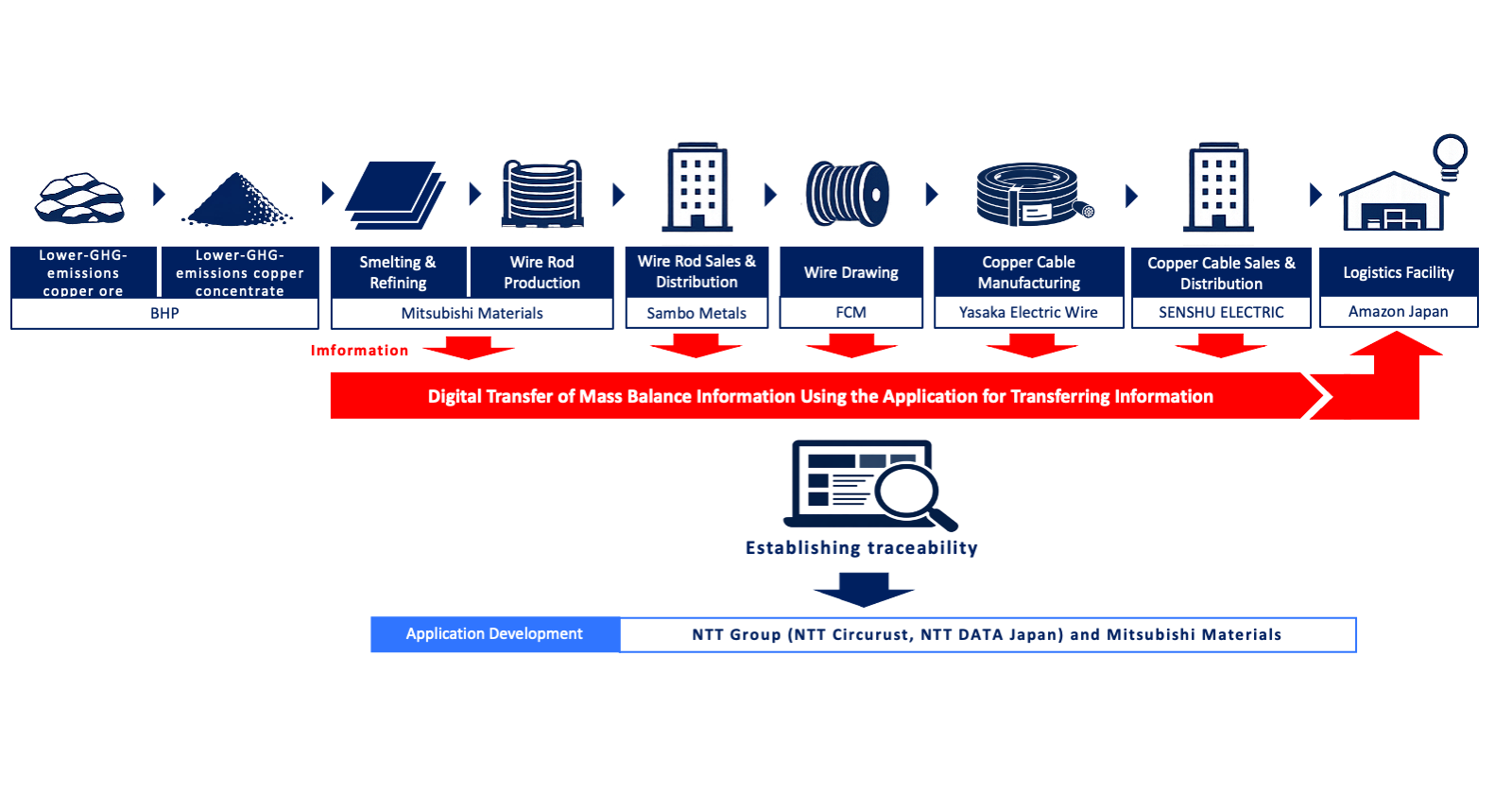
Therefore, in this demonstration, MMC will first smelt copper concentrate(*2) produced at the BHP-operated Escondida Copper Mine in Chile—where operational GHG emissions have been reduced by sourcing 100% of purchased electricity from renewable energy—and process it into wire rod. FCM Corporation and Yasaka Electric Wire will then process wire rod sold by Sambo Metals into copper cables, which will be implemented at the logistics facility of Amazon Japan G.K. through SENSHU ELECTRIC. The environmental attributes will be managed in accordance with the "Guidelines of Mass Balance Credit Model for Copper Products"(*3), and NTT Circurust, and NTT DATA Japan will verify the effectiveness of information-transferring processes intended to ensure traceability and transparency. Through this demonstration test, the companies aim to clarify issues and identify next steps toward widespread adoption of reliable value chains for copper cables made from lower-GHG-emissions copper ore, contributing to a more sustainable society.
The image of this demonstration test is as follows:
In its Medium-term Management Strategy (FYE March 2027-2029), the MMC Group has placed at the core of its group management the transformation into a company committed to "creating the future through resource circulation." MMC supports the purpose of this demonstration test, which is to deliver the environmental value of lower-GHG copper ore generated by the BHP Group at mines to end consumers through the value chain, and will participate as a partner responsible for the smelting and processing processes.
Through this demonstration test, MMC will accumulate practical knowledge for visualizing, appropriately managing, and communicating environmental value, and will contribute, through collaboration with the companies involved, to creating a mechanism for the social implementation of environmentally conscious products.
(*1) A mass balance model that uses a method of issuing credits for specific characteristics possessed by raw materials and attributing the issued credits to products or parts of products. A mass balance model is one of the five Chain of Custody models defined in ISO 22095:2020, under which raw materials or products with specific characteristics are mixed with raw materials or products without those characteristics in accordance with defined criteria. Chain of Custody refers to the process by which inputs and outputs, as well as related information, are transferred, monitored, and controlled as they pass through each stage of the relevant value chain.
(*2) A raw material produced by crushing and processing copper ore to increase its copper content.
(*3) A guideline that clarifies the rules for applying the mass balance credit model to copper products. This guideline was formulated by MMC and has been confirmed by a third party to comply with ISO 22095 and ISO 22095-2, which was issued in January 2026.
[Related Release]
April 27, 2026 Establishment of the "Guideline of Mass Balance Credit Model for Copper Products"
URL: https://www.mmc.co.jp/corporate/en/news/2026/news20260427.html
End
<Contact details for inquiries>
Corporate Communications Dept.
+81-3-5252-5206