







Start of Provision of Electron Transport Layer Ink Samples for Perovskite Solar Cells
- Electron transport materials contributing to cost reduction and mass production -
Mitsubishi Materials Corporation
Mitsubishi Materials Corporation ("MMC") has started providing ink samples for electron transport layers with an eye to commercialization of perovskite solar cells. These inks achieve high power conversion efficiency while using low-cost materials, and their material design, which is suitable for solution-based coating processes, is expected to lead to stable and scalable manufacturing.
In recent years, the development of perovskite solar cells, which are lightweight, flexible, and have a high degree of freedom in installation location, has accelerated toward achieving carbon neutrality. Perovskite solar cells are composed of multiple functional layers, and their performance is highly dependent on the material properties of each layer. In particular, the electron transport layer (*1) is an important layer that is responsible for efficiently extracting and transporting the generated electrical charges.
(*1) A layer that selectively transports photogenerated electrons from the perovskite layer to the current collector while blocking hole transport
Regarding the electron transport layer, there are several challenges in terms of improving power conversion efficiency and stable manufacturing. Specifically, it is necessary to minimize the electrical losses at the interface with the perovskite layer and to form a uniform film in order to reduce variations in device performance. In addition, since both the film substrate and the perovskite layer are susceptible to heat and processing conditions, the use of low-temperature processes that do not cause damage to these layers is also an important challenge.
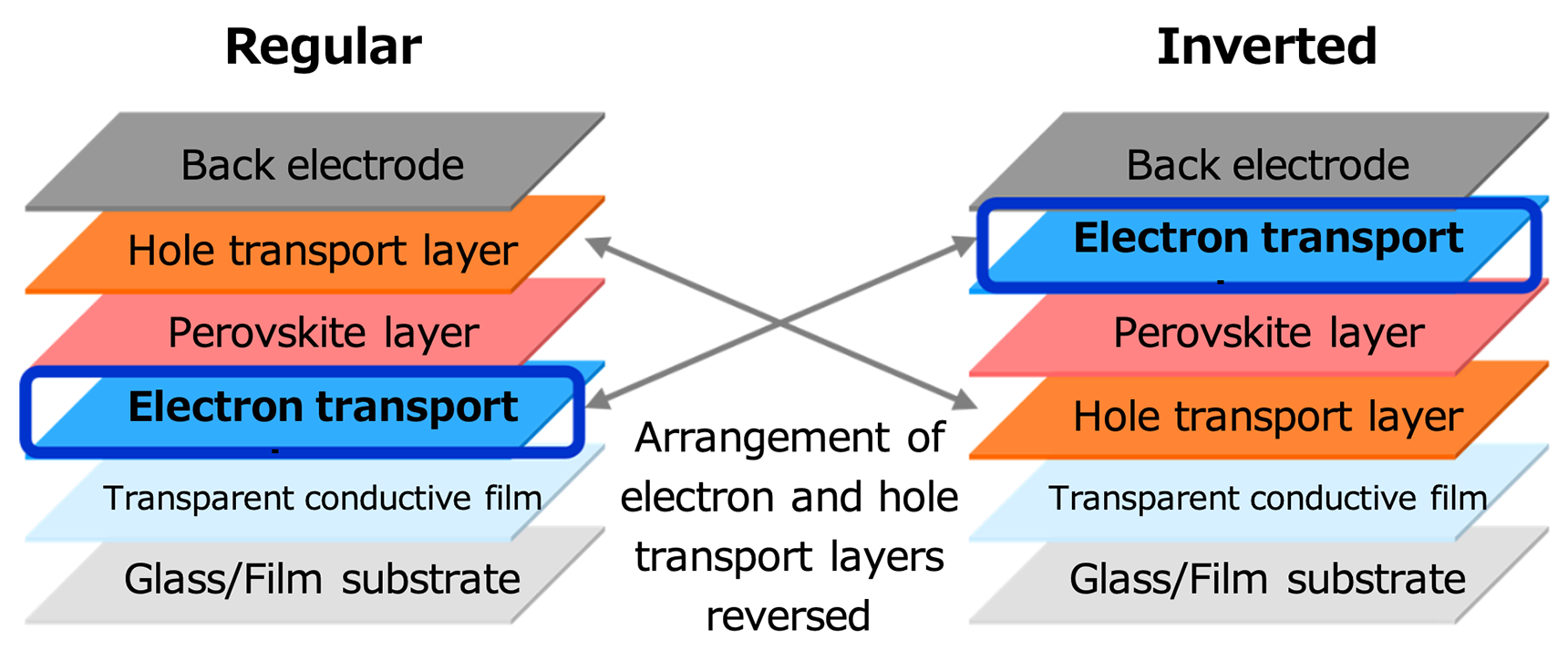
To meet these challenges, MMC's Innovation Center (Naka City, Ibaraki Prefecture) has been working to develop tin oxide (SnO2) nanoparticle inks. There are two types of perovskite solar cell structures: regular and inverted structures. The materials required for the electron transport layer and the deposition methods are different for each type. From the fiscal years ended March 2023 through 2026, under the Green Innovation Fund program of NEDO(*2), MMC has been developing electron transport layer inks for regular and inverted structures at the same time through joint development with EneCoat Technologies Co., Ltd.
(*2) New Energy and Industrial Technology Development Organization
- 拡大
- Figure 1: Schematic diagram of a perovskite solar cell
- 拡大
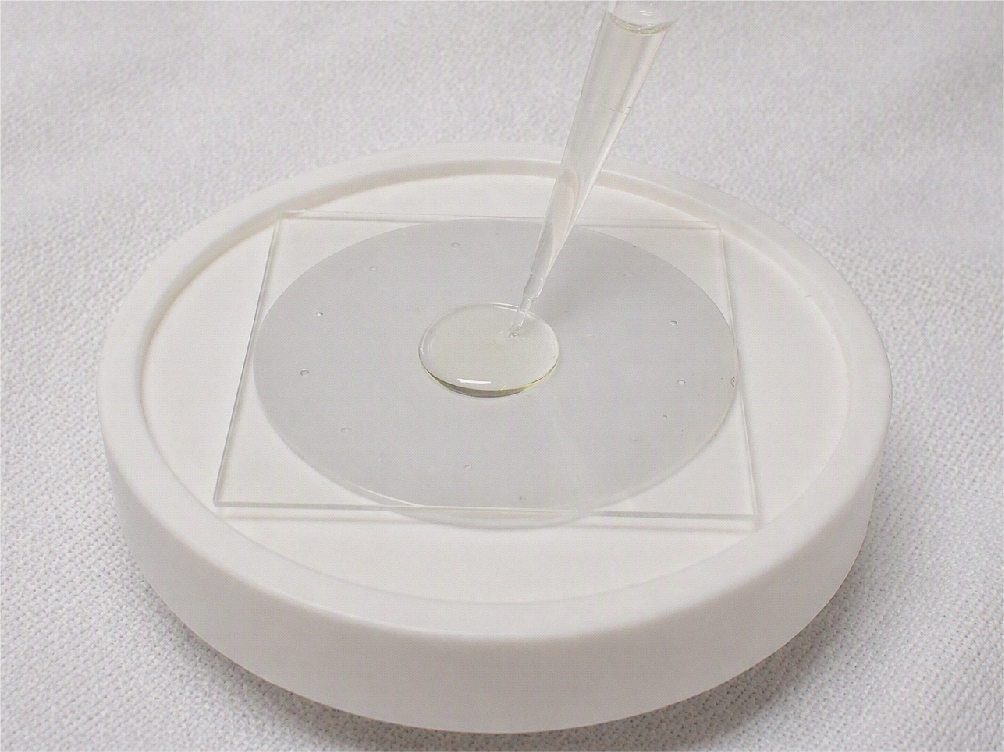
- Figure 2: Image of the coating process using tin oxide nanoparticle ink
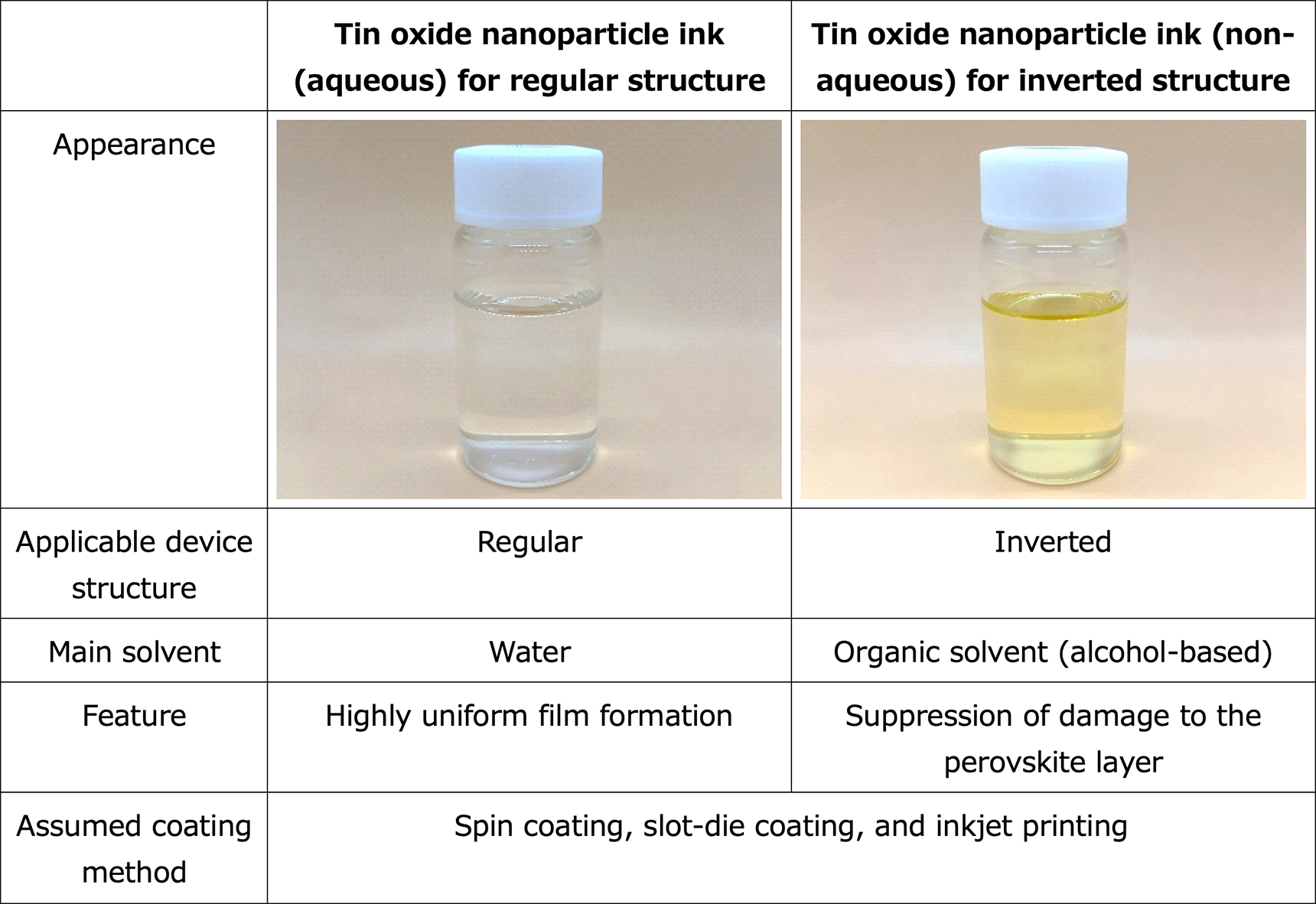
Based on the results of the technological achievements obtained to date, MMC will begin providing samples for external evaluation as part of its efforts toward practical application of perovskite solar cells. This ink is available in two types optimized for regular and inverted structures. It can be deposited using solution-based coating processes, which makes it suitable for large-area fabrication and reducing manufacturing costs. Moreover, by controlling the dispersion of nanoparticles, it is possible to form uniform and stable films, which is expected to enable highly reproducible manufacturing processes.
Table 1: Types of tin oxide nanoparticle inks provided for evaluation
MMC is also developing materials for both regular and inverted device structures, enabling material design optimized for the characteristics of each architecture. For the inverted structure in particular, MMC has already achieved a power conversion efficiency of 16.0% using a device structure that does not require expensive fullerene (C60), which is commonly used in electron transport layers. The resulting performance was approximately 1.5 times higher than that obtained with conventional commercial inks.
MMC will continue to refine product and application conditions based on customer feedback obtained through sample evaluation. At the same time, it will strive to further improve device performance and establish mass-production processes. This effort is based on the MMC Group's basic policy of becoming a company committed to "creating the future through resource circulation" set forth in its Medium-term Management Strategy (FYE March 2027-2029) and aims to contribute to the advancement of renewable energy through the development and commercialization of high-performance materials.
This achievement was obtained in part through the results of a project (JPNP21016) subsidized by the New Energy and Industrial Technology Development Organization (NEDO).
[Related Information]
Press release on March 24, 2025
Developed an Ink for Electron Transport Layer Deposition That Improves the Power Conversion Efficiency of Perovskite Solar Cells
URL: https://www.mmc.co.jp/corporate/en/news/2025/news20250324.html
Press release on March 28, 2022
Additional Financing to EneCoat Technologies Engaged in the Development of a Perovskite Solar Cell
URL: https://www.mmc.co.jp/corporate/en/news/2022/news22220413.html
Press release on May 20, 2020
(Japanese only) Financing to a Kyoto University spin-off Perovskite Solar Cell Startup
URL: https://www.mmc.co.jp/corporate/ja/news/press/2020/20-0520.html
End
<Contact details for inquiries>
Corporate Communications Dept.
+81-3-5252-5206